
Next-gen sequencing
We develop smart polymers for purification and labeling of DNA and RNA libraries to increase the efficiency and sensitivity of new diagnostic assays that rely on next-generation sequencing.
Chemistry · materials science · DNA nanotechnology
The Elisha Krieg lab develops programmable materials and nanodevices that use DNA molecules as structural elements and functional code.
Research focus
Synthetic polymer materials have revolutionized the world within the last century. Yet, a glance at nature reveals how limited the functions of synthetic polymers still are in comparison to biological matter: biological cells use molecular self-assembly and self-organization to build complex materials, such as the cytoskeleton, and to operate sophisticated macromolecular devices, such as motor proteins. For many years, chemists and material scientists have been intrigued by one question: How can we construct materials with equally sophisticated and versatile features?
Inspired by biology's refined design principles, our group strives to develop materials with programmable and reconfigurable properties. We use DNA as the quintessential component for these materials: aside from its crucial role as the carrier of genetic information, DNA can be used as a construction material to assemble artificial nanometer-scale structures. This research field at the interface of science and engineering is known as DNA nanotechnology.
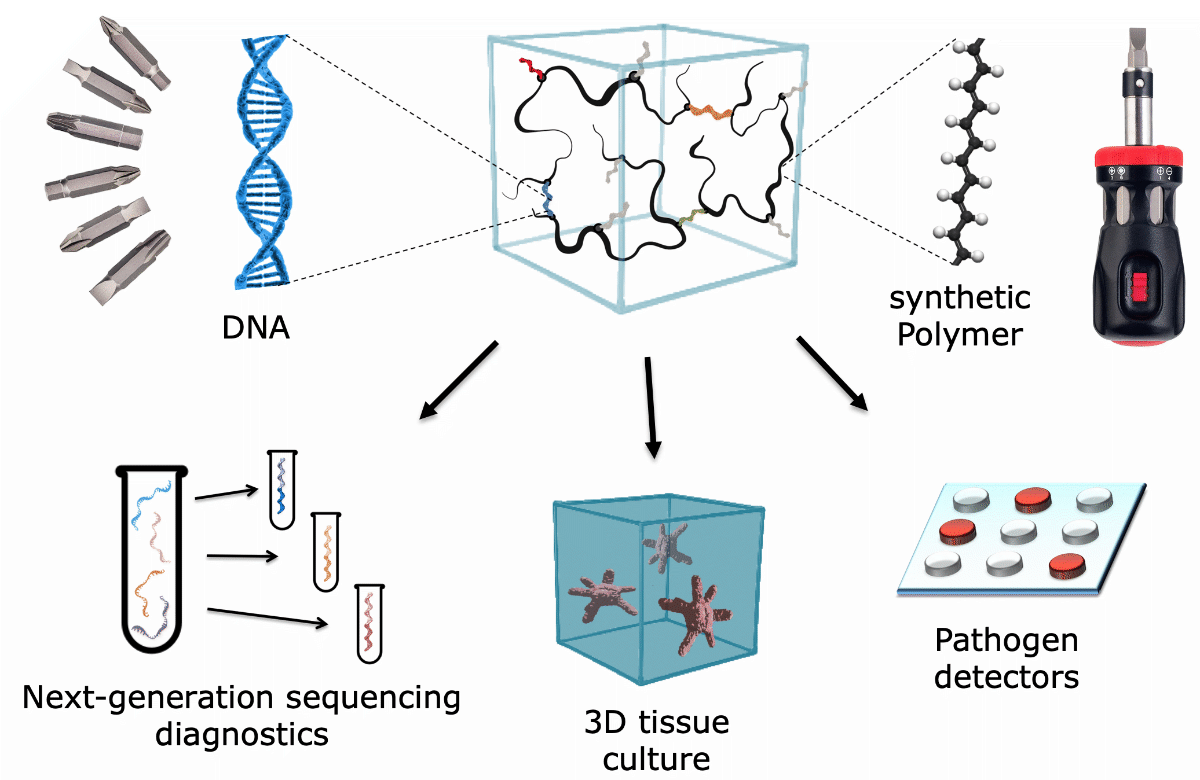
By combining concepts of DNA nanotechnology with traditional polymer chemistry and molecular biology, we aim to transfer the programmability and reconfigurability of nanometer-scale DNA devices to the macroscopic level. To this end, structural scaffolds of synthetic acryloyl polymers are endowed with DNA-based nanomodules via non-covalent self-assembly. The ultimate target is the development of new classes of materials that can be programmed to perform complex tasks for diverse biomedical applications.
We develop smart polymers for purification and labeling of DNA and RNA libraries to increase the efficiency and sensitivity of new diagnostic assays that rely on next-generation sequencing.
We engineer printable and dynamically reconfigurable 3D matrices for cell and organoid culture to generate better in vitro models of healthy and damaged tissues.
We design new assays based on dynamic DNA nanotechnology for point-of-care detection of pathogen-specific nucleic acids.
Translational research
Academic research in chemistry and materials science can do more than produce publications. We aim to create programmable materials that can have a transformative impact in life science research and biomedicine.
Dynamic Matrices, our nascent startup project, translates polymer materials with DNA-encoded properties into practical tools. Its DyNAtrix platform brings defined, DNA-programmable viscoelastic matrices to 3D cell culture. LASSO leverages a unique phase separation mechanism for ultra-specific biomolecule isolation.

Visit the Dynamic Matrices website
Watch the Leibniz Health-Tech Lecture by Elisha Krieg describing the DyNAtrix and LASSO technologies:
Opportunities
Projects can span polymer chemistry, DNA nanotechnology, molecular biology, microscopy, cell culture, and data analysis. MSc projects, doctoral routes, and postdoctoral inquiries are handled through the lab and partner programs.